DineHome
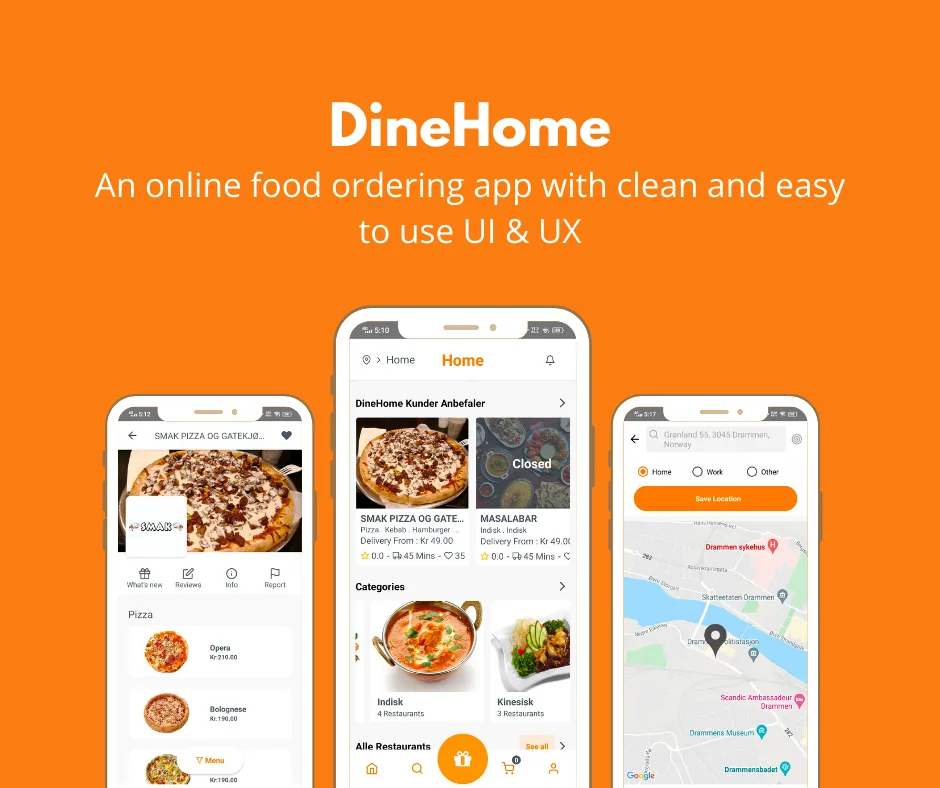
A three-app React Native and Firebase food delivery platform for Norway — customer ordering, kitchen POS, and rider apps built from scratch with the Hello World Technologies team, taking the business to its first 1,000+ orders and 50+ POS installs.
- First orders
- 1,000+
- POS terminals installed
- 50+
- Connected apps
- 3 (customer, kitchen, rider)
- Native modules built
- 3 (kiosk, printer, GPS)
Overview
DineHome is a multi-vendor food delivery platform in Norway that lets restaurants run their own delivery instead of paying commission to aggregators. Between 2018 and 2020 I was a core mobile engineer on the team at Hello World Technologies that built it from scratch.
The platform is three React Native apps on one shared Firebase backend: a customer app for ordering and live tracking, an Android POS app that runs as a locked-down kitchen terminal, and a rider app with real-time GPS. I worked across all three, plus the native Android and iOS modules that made the hardware side work.
By the time I moved on, the platform had processed its first 1,000+ orders and was installed on 50+ restaurant POS terminals — the foundation DineHome has since grown into one of Norway's larger delivery brands.
- Three React Native apps on one Firebase backend
- Android kiosk-mode POS in Java/Kotlin
- Native ESC/POS thermal printer module
- Background GPS streaming for live rider tracking
- Store releases and rollout to 50+ restaurants
Challenge
- Give restaurants a commission-free alternative to aggregators, which meant matching the ordering and tracking experience of much larger platforms with a small team.
- Keep three apps — customer, kitchen, and rider — perfectly in sync on one backend so an order placed on a phone appears in the kitchen instantly and reaches the right courier.
- Make the kitchen terminal unescapable during a shift: staff tapping Home or Back on a tablet meant missed orders and lost revenue.
- Print order tickets automatically on thermal printers and stream rider locations reliably, including with the screen locked — none of which React Native does out of the box.
Approach
- Built the customer, kitchen POS, and rider apps in React Native with TypeScript on a shared Firebase backend, using Firestore listeners so order state updates in real time across all three.
- Wrote native Android code in Java and Kotlin to harden the POS app into kiosk mode — overriding Home, Back, Recents, the power button, and gesture navigation so the terminal stays on the order screen.
- Built a custom React Native native module that formats confirmed orders into ESC/POS commands and prints them on the kitchen's thermal printer the moment an order lands.
- Implemented a background location service in the rider app that pushes GPS coordinates to Firebase continuously, so customers see live tracking without polling.
- Handled App Store and Google Play releases for all three apps and supported the rollout to restaurants as the network grew from the first venues to 50+ POS installs.
Features
- React Native
- TypeScript
- Firebase & Firestore
- Native modules (Java/Kotlin/Swift)
- Kiosk mode POS
- Thermal printing (ESC/POS)
- Background GPS tracking
- Real-time order sync
More work
All projects




Similar Project?
Have a similar project?
If you need a mobile product with clear delivery ownership, I can help shape the build, the backend, and the release path.